Detecting and quantifying entanglement on near-term quantum devices

May 9, 2022·
Kun WANG
Kun WANG
,
Zhixin Song
,
Xuanqiang Zhao
,
Zihe Wang
,
Xin Wang
· 0 min read
Abstract
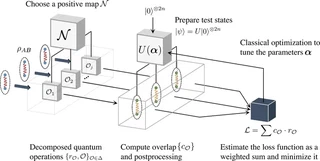
Quantum entanglement is a key resource in quantum technology, and its quantification is a vital task in the current noisy intermediate-scale quantum (NISQ) era. This paper combines hybrid quantum-classical computation and quasi-probability decomposition to propose two variational quantum algorithms, called variational entanglement detection (VED) and variational logarithmic negativity estimation (VLNE), for detecting and quantifying entanglement on near-term quantum devices, respectively. VED makes use of the positive map criterion and works as follows. Firstly, it decomposes a positive map into a combination of quantum operations implementable on near-term quantum devices. It then variationally estimates the minimal eigenvalue of the final state, obtained by executing these implementable operations on the target state and averaging the output states. Deterministic and probabilistic methods are proposed to compute the average. At last, it asserts that the target state is entangled if the optimized minimal eigenvalue is negative. VLNE builds upon a linear decomposition of the transpose map into Pauli terms and the recently proposed trace distance estimation algorithm. It variationally estimates the well-known logarithmic negativity entanglement measure and could be applied to quantify entanglement on near-term quantum devices. Experimental and numerical results on the Bell state, isotropic states, and Breuer states show the validity of the proposed entanglement detection and quantification methods.
Type
Publication
npj Quantum Information
publication research
Kun WANG
Authors
Associate Researcher

I am an Associate Researcher and Outstanding Young Talent in the College of Computer Science and Technology, National University of Defense Technology (NUDT).

My research develops practical foundations for reliable and scalable quantum information processing. I work across photonic quantum computing, quantum characterization, verification and validation, distributed quantum estimation, and quantum information theory.

Before joining NUDT, I was a Senior Researcher at the Institute for Quantum Computing, Baidu Research, from 2020 to 2023. I led the development of the Quantum Error Processing (QEP) toolkit for characterizing, mitigating, and correcting errors in quantum devices through software. I received the Shenzhen Industrial Development and Innovation Talent Award in 2023.

Previously, I was a postdoc at the Shenzhen Institute for Quantum Science and Engineering (SIQSE), Southern University of Science and Technology, where I worked with Prof. Masahito Hayashi.