Physical Implementability of Linear Maps and Its Application in Error Mitigation

Dec 7, 2021·
Jiaqing Jiang
Equal Contribution
Kun WANG
Kun WANG
Equal Contribution
,
Xin Wang
· 0 min read
Abstract
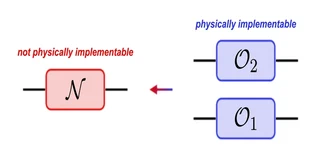
Completely positive and trace-preserving maps characterize physically implementable quantum operations. On the other hand, general linear maps, such as positive but not completely positive maps, which can not be physically implemented, are fundamental ingredients in quantum information, both in theoretical and practical perspectives. This raises the question of how well one can simulate or approximate the action of a general linear map by physically implementable operations. In this work, we introduce a systematic framework to resolve this task using the quasiprobability decomposition technique. We decompose a target linear map into a linear combination of physically implementable operations and introduce the physical implementability measure as the least amount of negative portion that the quasiprobability must pertain, which directly quantifies the cost of simulating a given map using physically implementable quantum operations. We show this measure is efficiently computable by semidefinite programs and prove several properties of this measure, such as faithfulness, additivity, and unitary invariance. We derive lower and upper bounds in terms of the Choi operator’s trace norm and obtain analytic expressions for several linear maps of practical interests. Furthermore, we endow this measure with an operational meaning within the quantum error mitigation scenario: it establishes the lower bound of the sampling cost achievable via the quasiprobability decomposition technique. In particular, for parallel quantum noises, we show that global error mitigation has no advantage over local error mitigation.
Type
Publication
Quantum
publication research
Kun WANG
Authors
Associate Researcher

I am an Associate Researcher and Outstanding Young Talent in the College of Computer Science and Technology, National University of Defense Technology (NUDT).

My research develops practical foundations for reliable and scalable quantum information processing. I work across photonic quantum computing, quantum characterization, verification and validation, distributed quantum estimation, and quantum information theory.

Before joining NUDT, I was a Senior Researcher at the Institute for Quantum Computing, Baidu Research, from 2020 to 2023. I led the development of the Quantum Error Processing (QEP) toolkit for characterizing, mitigating, and correcting errors in quantum devices through software. I received the Shenzhen Industrial Development and Innovation Talent Award in 2023.

Previously, I was a postdoc at the Shenzhen Institute for Quantum Science and Engineering (SIQSE), Southern University of Science and Technology, where I worked with Prof. Masahito Hayashi.